AI Ready — Or Just Using AI?
Take the AI Readiness Assessment →



There’s a quiet shift happening in project management right now.
Not just the headline-grabbing promise of AI—automation, workflows, and faster delivery—but a deeper shift in how teams operate. Something more practical. And arguably more important.
It’s a shift in who does what.
For decades, project managers have been the connective tissue of delivery, juggling timelines, resources, risks, and stakeholders. But much of that work has been administrative: updating plans, chasing status, reconciling spreadsheets, and manually stitching together fragmented data.
Now, AI is starting to take on that burden. And in doing so, it’s forcing a rethink of the PM role itself.
Accelo’s CEO, Joe DiPaulo, and The Digital Project Manager’s VP of AI, Tim Fisher, recently explored this shift in depth, discussing AI project management in professional services: what’s real, what’s working, and where the future is headed. Listen in to the full discussion now:
When AI enters the professional services conversation, the fear is predictable: Will AI replace project managers?
But that framing misses the point.
AI in project management for professional services isn’t about replacement—it’s about elevation. AI takes on the work that doesn’t require human judgment, so project managers can focus on what does.
Joe DiPaulo puts it more bluntly, “Professional services organizations have historically scaled by adding people. AI introduces a different path: scaling performance without scaling headcount.”
AI for consulting firms introduces a different path: scaling performance without scaling headcount.
That distinction matters. The real constraint in project delivery has never been a lack of people; it’s been a lack of visibility, predictability, and time to think. AI doesn’t remove the need for project managers. It removes the friction that prevents them from doing their best work.
Traditional project management is reactive by design.
Issues surface late. Margin erosion happens gradually. Resource conflicts are discovered after the fact. By the time a PM intervenes, the damage is already underway.
AI project management in professional services changes the timing.
Instead of reporting on what happened, AI-powered PSA software, like Forecast, an Accelo company, surfaces what’s likely to happen next.
In the webinar, DiPaulo described a few early signals that Forecast detects…
…all of which are identified before they become visible in traditional reporting.
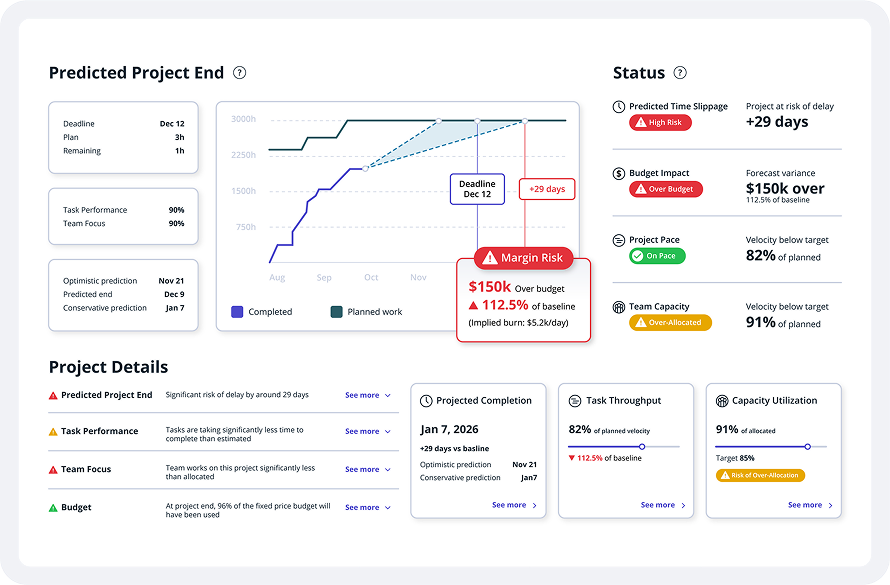
Forecast’s AI-powered PSA software is more than automation. It’s a shift in posture:
And that shift fundamentally changes how a project manager spends their time: less firefighting and more forward-looking decision-making. What could your team do with less manual, reactive work and more time where it matters most? Book a demo now.
For all the promise of AI, there’s a more fundamental issue that determines whether it actually delivers value: how connected your data is. As an example, spreadsheets are commonly used in professional services. But when teams manage delivery through disconnected systems and spreadsheets, what’s lost is:
And when that happens, project managers are pulled back into the very work AI is supposed to eliminate—manual updates, chasing information, and reconciling conflicting data.
Is your organization equipped to leverage AI effectively? Find out in 3 minutes.
DiPaulo calls out a common misconception that spreadsheets make teams more agile. In reality, they break down as complexity grows, introducing errors, delays, and missed signals.
This is where AI starts to deliver real value, not just through automation, but through context.
Forecast’s AI-powered PSA software doesn’t just replace spreadsheets; it unifies operational data across projects, resources, and financials, creating a continuously updated source of truth. And that unlocks something project managers have historically lacked: the ability to see what’s happening, where projects are predicted to land, what’s at risk, and what to do next, in real time.

One of the more interesting developments isn’t just AI generating insights; it’s AI becoming interactive.
During the webinar, DiPaulo demo’d Forecast’s Model Context Protocol (MCP), which allows project managers and leaders to query operational data in natural language.
Instead of navigating dashboards or building reports, imagine asking—and getting answers—in seconds. MCP isn’t just convenience; it changes how decisions are made. In many cases, this kind of interaction has the potential to replace recurring status meetings entirely, replacing hours of manual reporting with instant, contextual insight.
And yet, the human project management role doesn’t disappear. It evolves.
If AI for consulting firms takes on planning, forecasting, reporting, and even some execution, what’s left?
Quite a lot, actually.
DiPaulo’s view is clear: there will still be a need for people to orchestrate outcomes—to define inputs, interpret outputs, ensure delivery quality—and, most importantly, to build relationships, both internally and with clients.
In other words, the project manager's role becomes less about managing tasks and more about managing intent.
Future project managers will likely spend more time:
And less time:
In other words, AI project management in professional services isn’t a replacement for a role; it’s a redistribution toward more strategic work.
There’s a persistent narrative that AI for consulting firms will eventually replace collaboration, conversation, and intuition. But even in highly automated environments, those elements remain critical.
“AI can recommend, analyze, and optimize, but it can’t fully replicate human context: understanding someone’s aspirations, navigating ambiguity, or building trust within a team,” noted DiPaulo.
In fact, as AI handles more operational work, the value of those human skills only increases.
Looking ahead, the conversation will shift again, from AI as an assistant to AI as an active contributor.
We’re already seeing early signs of this with agent-based systems that can:
DiPaulo expects this phase to accelerate quickly, with agents acting as “workers” within professional services organizations over the next 12–36 months.
For project managers, this introduces a new layer of responsibility: not just managing people, but managing a hybrid workforce of humans and AI.
There’s a temptation to frame AI project management in professional services as a way to “do less.”
That’s not quite right.
It’s about doing different work.
The administrative weight that has defined project management for years is starting to lift. In its place is something more strategic, more human, and arguably more valuable.
AI in consulting firms isn’t removing the need for project managers.
It’s finally giving them the space to be what they were always meant to be.
The shift toward AI-powered project management isn’t theoretical; it’s already changing how professional services teams plan, deliver, and scale. Curious how AI project management could work in your organization? See how Forecast’s AI-powered PSA software helps you plan smarter, allocate resources more effectively, and stay ahead of project risks. Book your demo today.
AI project management for professional services refers to the use of artificial intelligence to improve how teams plan, deliver, and manage client work. Instead of relying on manual processes, AI helps automate repetitive tasks, surface risks earlier, and provide predictive insights, allowing project managers to focus on strategy, client relationships, and decision-making.
AI-powered PSA software, like Forecast, improves project delivery by providing real-time visibility into resources, timelines, and financial performance. The AI engine identifies risks, such as budget overruns or resource constraints, before they escalate and recommends actions to keep projects on track. AI for consulting firms enables professional services teams to operate more proactively and consistently.
No—AI for consulting firms is not replacing project managers. Instead, it’s elevating their role. AI takes on administrative and data-heavy tasks, freeing project managers to focus on higher-value work like stakeholder communication, strategic planning, and ensuring successful outcomes. The project manager role evolves from task management to orchestration.
Consulting firms should look for AI-powered PSA software that connects data across projects, resources, and financials into a single system of record. Key capabilities include predictive forecasting, resource optimization, real-time reporting, and the ability to surface actionable insights. The goal is not just automation, but better visibility and smarter decision-making. To see this in practice, book a demo of Forecast’s AI-powered PSA software.


