Key Takeaways:
- The most profitable professional services organizations don't aim for 100% utilization—they aim for the Goldilocks Zone.
- Industry benchmarks suggest the sweet spot sits between 70% and 80%: high enough to maximize revenue, but low enough to give teams room to respond to changing priorities, support clients, and avoid burnout.
- The real challenge isn't squeezing more hours out of your people; it's making smarter capacity decisions.
If you've ever looked at a utilization report and thought, "We should be aiming higher," you're not alone.
For years, utilization rates have been treated as one of the defining measures of operational health in professional services. On paper, the logic seems straightforward: if more client hours equal more revenue, then higher utilization should mean higher profits.
But the data tells a more nuanced story.
Industry benchmarks consistently point to a Goldilocks Zone for utilization, typically between 70% and 80%. That's the point where organizations are busy enough to be profitable without pushing teams toward burnout or limiting their ability to take on new business. Push much beyond that, and the costs start to outweigh the gains.
According to industry benchmarks:
- The average utilization rate across professional services organizations sits at 66%, well below the range considered optimal for profitability.
- The recommended utilization "Goldilocks Zone" is 70%-80%.
- Among agencies, 39% set utilization targets of 70–79% for mid-level employees, while 35% aim for 80–89%.
- Organizations consistently operating above 80% utilization are more likely to experience employee attrition and declining long-term performance.
Sources: SPI Research Professional Services Maturity Benchmarks, 2025 & 2026; SparkToro State of Digital Agencies, 2026
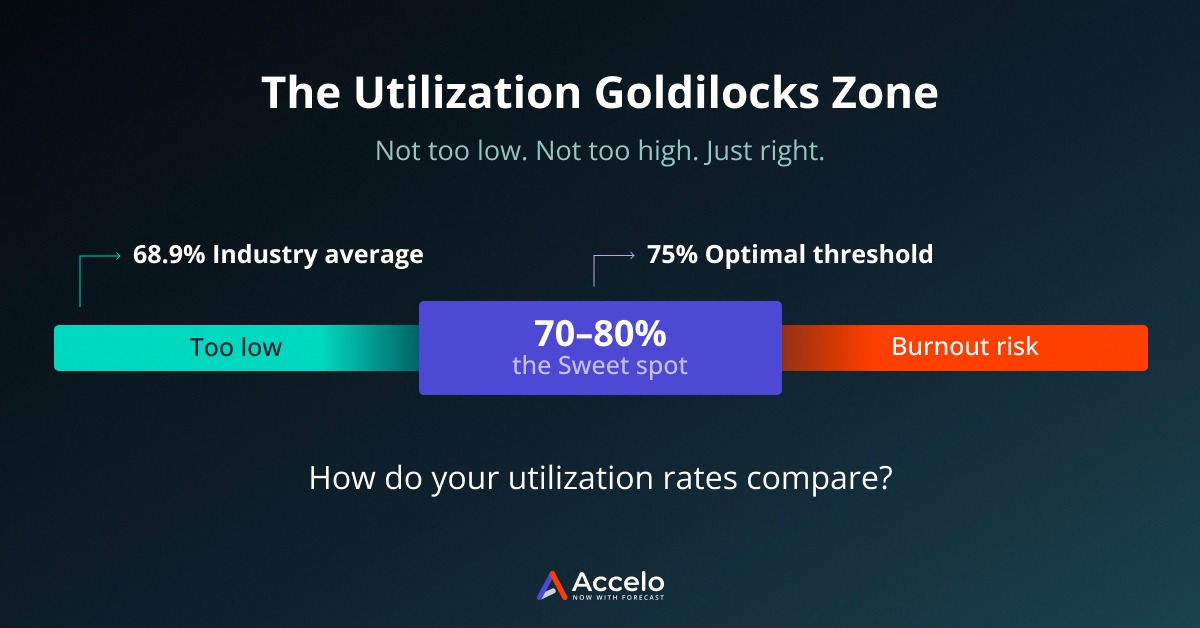
For many firms, the more immediate problem is actually underutilization. That gap is bench time, and pricing it properly is what bench management is for. And the financial stakes are significant: too low of utilization and firm profitability may suffer. The point isn't that firms should stop trying to raise utilization; it's that they should know when to stop.
At some point, every additional billable hour comes at the expense of something else: flexibility, quality, client responsiveness, employee wellbeing, or the ability to take on new opportunities. That's the Goldilocks dilemma: too hot matters just as much as too cold.
Finding the Right Level of Resource Utilization
Finding your resource utilization sweet spot means avoiding both extremes. Too little billable work leaves revenue and profit on the table; too much leaves the business without enough capacity to adapt.
For many professional services firms, the first problem is the more familiar one. Underutilization can signal gaps in demand, poor resource allocation, or too much time between projects, and even small improvements can have an outsized effect on profitability.
But there is a point where the equation changes.
Capacity has value even when it isn't billable. Operating below maximum utilization gives your team room to absorb a change request without derailing another project. It allows a senior consultant to mentor a new hire instead of rushing to the next client meeting. It creates space to respond when a strategic opportunity lands in your pipeline and, just as importantly, gives people the flexibility to take well-earned time off.
Without that buffer, every unexpected request has to displace something else.
That's why organizations operating above the Goldilocks Zone often experience diminishing returns. As resource utilization climbs, flexibility falls. Small disruptions become bigger ones, delivery becomes less predictable, and the business has fewer options when priorities inevitably change.
The goal isn't to eliminate every spare hour. It is to schedule work so utilization lands in a range you can sustain. If you want to move that number, start with resource scheduling strategies for higher utilization.
It's to protect enough capacity for the work that keeps your business healthy, adaptable, and profitable over the long term.
Utilization is a metric. Capacity management is a strategy.
Finding the right level of resource utilization is only half the challenge. The other half is knowing whether your capacity is in the right place.
Resource utilization measures how much of your team's available time is spent on billable work. Capacity management looks at the bigger picture: whether you have the right people, skills, and capacity to meet current and future demand.
For an underutilized team, that may mean finding ways to move more available capacity into billable work. For an over-utilized team, it may mean deliberately protecting some of it.
The goal isn't simply to move utilization up or down. It's to make sure the capacity you have supports where the business needs to go next.
That's what separates measuring utilization from managing capacity.
The Best Capacity Decisions Go Beyond Resource Utilization
A good capacity decision balances today's workload with tomorrow's demand. It isn't just about filling this week's schedule; it's about ensuring your business has the people, skills, and capacity to deliver what's next.
Should you start a new project next Monday or wait two weeks? Do you hire, redistribute work, or bring in a contractor? Can your top solution architect support another implementation, or will that put three existing projects at risk?
Those decisions can't be answered by a utilization report alone. They require forward-looking resource capacity planning: understanding future demand, available capacity, project priorities, and where bottlenecks are likely to emerge before they affect delivery.
Not all capacity needs to be billable to be valuable. Capacity that allows you to absorb change, onboard a new client, or improve an internal process isn't wasted; it's strategic capacity.
That's an important shift in thinking. The goal isn't to maximize billable hours on a dashboard. It's to make capacity decisions that keep your business profitable, resilient, and ready for what's next.
The Cost of Pushing Resource Utilization Too Far
Above a certain point, every additional billable hour becomes more expensive than it looks.
The reason is simple: the biggest costs of over-utilization rarely appear on a utilization report. They show up later in employee turnover, delayed projects, missed opportunities, and clients who can't wait for your next available consultant.
The examples below illustrate how quickly those hidden costs can outweigh the revenue gained by pushing utilization beyond the Goldilocks Zone.
Scenario 1: Chasing another 10% utilization
Assume a consultant bills at $200/hour and has 1,800 available hours each year.
Increasing utilization from 80% to 90% creates:
- Additional billable hours: 180
- Additional revenue: $36,000
That looks like an easy win.
But now assume that sustained over-utilization contributes to losing that consultant.
Even before considering lost client relationships, replacing them means:
- ~8 weeks (or more) with reduced delivery capacity
- Onboarding and mentoring time from senior consultants
- Months before reaching full billability
- Institutional knowledge walking out the door
For many professional services firms, those costs quickly exceed the $36,000 gained by squeezing another 10% utilization out of one person. Industry estimates place employee replacement costs at 50–200% of annual salary, depending on the role.
The cost isn't the 10% of time you didn't bill. It's the people you lose—and the opportunities you miss—trying to bill the other 10%.
Scenario 2: The opportunity cost
Imagine the same team is operating at 90% utilization when Sales closes a new enterprise client worth $400,000 annually.
Delivery can't start for eight weeks because the right people aren't available.
At that point, the business has four options:
- Delay the start date
- Bring in contractors or freelancers
- Hire reactively
- Hope the client is willing to wait
None of those options is free. Contractors can protect delivery, but they often come at a higher cost and need time to get up to speed. Hiring reactively takes months. And if the client can't wait, they may simply choose a competitor that can take them on immediately.
Suddenly the extra revenue you gained from pushing utilization higher doesn't look nearly as attractive; the extra utilization you gained today may have limited the growth you needed tomorrow.
Finding Your Goldilocks Zone
The Goldilocks Zone isn't about lowering utilization. And it certainly isn't about accepting idle time. It's about finding the point where utilization supports profitability without sacrificing the capacity your business needs to adapt and grow. The healthiest professional services businesses are the ones that consistently make better capacity decisions, balancing utilization with flexibility, protecting their teams from burnout, and leaving enough room to respond when opportunities arise.
That's why Accelo approaches resourcing and capacity planning differently. By combining AI-powered resource management with real-time visibility into utilization, workload, and forecasting future demand, firms spend up to 50% less time scheduling and reacting to capacity problems, and more time on work that advances the business.
Because maximum utilization isn't the goal.
Maximum business performance is.
To discuss how Accelo can help your organization optimize resource utilization while improving business performance, book time with our team.
FAQs About Resource Utilization
What is a good resource utilization rate?
Industry benchmarks generally place the Goldilocks Zone between 70% and 80%. The ideal target depends on your firm's business model, team structure, and individual roles, but consistently pushing utilization above that range can reduce flexibility, increase burnout, and make it harder to respond to new opportunities.
Can resource utilization be too high?
Yes. While higher utilization can increase billable revenue in the short term, sustained over-utilization often leads to bottlenecks, burnout, delayed project delivery, and missed growth opportunities. That's why many professional services organizations aim to optimize utilization rather than maximize it.
What's the difference between resource utilization and capacity management?
Resource utilization measures how much of your team's available time is spent on billable work. Capacity management is the broader discipline of ensuring you have the people, skills, and availability to meet current and future demand. Utilization is one input into effective capacity management, but not the whole picture.
How does resource capacity planning improve profitability?
Resource capacity planning helps firms balance current workload with future demand, identify bottlenecks before they impact delivery, and make better staffing decisions. By improving visibility into future capacity, firms can protect profitability while avoiding the hidden costs of over-utilization.
How does Accelo help teams optimize resource utilization and make better capacity decisions?
Accelo gives professional services leaders a real-time view of resource utilization, workload, project demand, and future capacity in one place. AI-powered recommendations help identify bottlenecks, match work to the right people, and support better capacity decisions, so firms can maximize profitability without pushing teams beyond sustainable utilization.


.svg)



.svg)